 DIPTI METAL INDUSTRIES
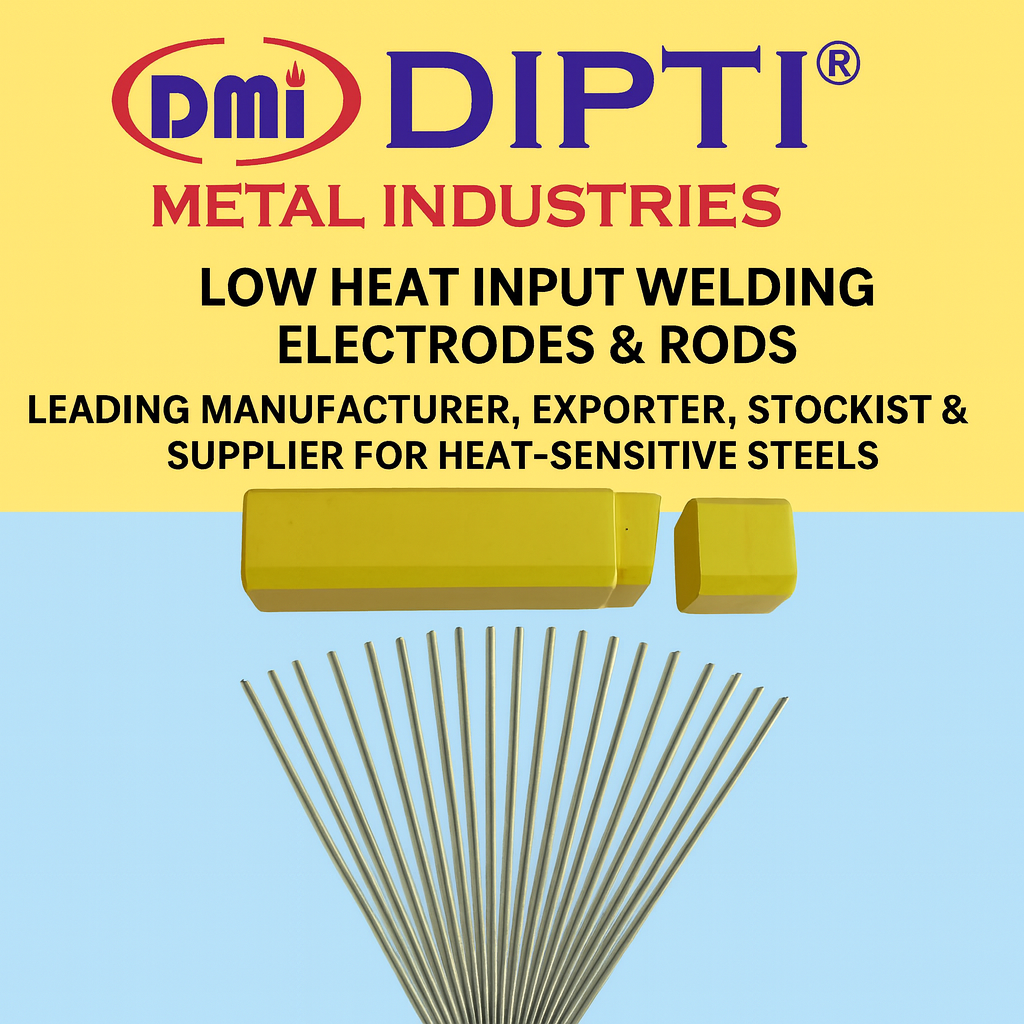
Low Heat Input Welding Electrodes & Rods - Leading Manufacturer, Exporter, Stockist & Supplier for Heat-Sensitive Steels
DIPTI METAL INDUSTRIES – Your Premier Worldwide Low Heat Input Welding Electrodes Exporter, Global Specialty Welding Rods Stockist, Top Low Hydrogen Electrodes Supplier, and Best Heat-Sensitive Steel Welding Consumable Dealer for critical fabrication of high-strength low-alloy (HSLA) and quenched & tempered (Q&T) steels, pressure vessels, offshore structures, and cryogenic storage. Established in 2009, we are an ISO 9001:2015 certified firm based in Mumbai, India, recognized as the leading Low Heat Input Welding Electrodes manufacturer in Mumbai and a top specialty welding rods exporter in India. We specialize in meticulously sourced, precision-formulated Low Heat Input Welding Electrodes and Rods. These are specifically designed to minimize the heat transferred to the base metal during welding, which is crucial for preventing adverse microstructural changes, hydrogen-induced cracking, embrittlement, and maintaining the exceptional mechanical properties of the parent material.
Our comprehensive range of Low Heat Input Electrodes includes grades like E7016-1, E7018-1, E8018-C1/C3, E9018-G, E10018-G, E11018-G, and E12018-G, covering a wide spectrum of strength levels and application requirements, ensuring superior notch toughness and crack resistance. We ensure optimal performance and full compliance for your most challenging projects in sectors such as offshore construction, cryogenic storage, power generation, and military applications. We maintain a large stock to serve as the biggest specialized low heat input electrode stockist, ensuring immediate dispatch for urgent industrial needs globally. Every electrode is supplied with full material traceability via EN 10204 3.1 MTCs, validating our position as a top material supplier for critical industrial service.
Overview & Importance: Why Choose a Leading Low Heat Input Welding Electrodes Manufacturer
Low Heat Input Welding Electrodes are precisely formulated for welding heat-sensitive steels, particularly high-strength low-alloy (HSLA) steels and quenched and tempered (Q&T) steels. Their unique design minimizes the heat transferred to the base metal during welding. This is crucial for preventing adverse microstructural changes, hydrogen-induced cracking, embrittlement, and maintaining the exceptional mechanical properties of the parent material, which are vital for the integrity of welded structures and components.
As a major global Low Heat Input Welding Electrodes manufacturer and Specialty Welding Rods supplier in Mumbai, DIPTI METAL INDUSTRIES provides a diverse range of these essential consumables, ensuring optimal performance across a spectrum of critical fabrication and repair needs. The inherent advantages of our specialized Low Heat Input Electrodes include:
- Superior Notch Toughness: Engineered to deliver exceptional impact toughness, often at extremely low temperatures (down to -60°C / -76°F), making them ideal for cryogenic and cold climate applications.
- Optimized for Heat-Sensitive Steels: Crucial for maintaining the properties of quenched and tempered (Q&T) steels and other HSLA alloys, preventing over-tempering or brittle zones.
- Exceptional Crack Resistance: Features basic low-hydrogen coatings (H4R / H5 ratings) to drastically reduce diffusible hydrogen, preventing hydrogen-induced cracking and ensuring high integrity welds.
- Preserves Base Metal Properties: By minimizing heat input, these electrodes prevent the degradation of the base metal's strength and toughness, which can occur with conventional welding.
As a top Low Heat Input Welding Rods exporter in India, we guarantee high-quality electrodes that conform to AWS A5.5 / ASME SFA 5.5, ISO 2560-A, and other relevant international standards, ensuring robust and reliable performance for critical applications worldwide. See our full range of welding electrodes and rods.
Key Features & Unmatched Benefits of Dipti Metal's Low Heat Input Welding Electrodes
- Optimized for Heat-Sensitive Steels: Specifically designed to minimize heat input during welding, crucial for maintaining the properties of quenched and tempered (Q&T) steels and other HSLA alloys.
- Superior Crack & Embrittlement Resistance: Features basic low-hydrogen coatings (H4R / H5 ratings) to drastically reduce diffusible hydrogen, preventing hydrogen-induced cracking and ensuring high integrity welds.
- Excellent Notch Toughness: Engineered to deliver superior impact toughness, often at extremely low temperatures (down to -60°C / -76°F), making them ideal for cryogenic and cold climate applications.
- Controlled Welding Techniques: Designed to perform optimally with stringer bead techniques, avoiding excessive weaving to further minimize heat input and preserve base metal properties.
- High Strength & Ductility: Provides weld metal with exceptional tensile and yield strengths, along with good ductility, ensuring robust and reliable joints for critical load-bearing structures.
- Full Compliance & Traceability: All electrodes are sourced from manufacturers who strictly adhere to AWS A5.5, ISO 2560-A, and IS 814 standards, ensuring consistent quality and full material traceability (with EN 10204 3.1 MTCs), guaranteeing reliable performance for highly regulated industries globally.
- Enhanced Metallurgical Integrity: Prevents undesirable microstructural changes in the heat-affected zone (HAZ), preserving the optimal properties of the base metal.
Low Heat Input Welding Electrode Grades We Stock (AWS A5.5 / ASME SFA 5.5)
DIPTI METAL INDUSTRIES offers a comprehensive range of AWS A5.5 Low Heat Input Welding Electrodes, carefully selected from advanced production facilities to meet specific project needs and performance criteria for critical welding applications. For other specialized welding needs, explore our Stainless Steel Welding Electrodes or Low Alloy High Tensile Electrodes.
This low-hydrogen potassium type electrode offers improved notch toughness at low temperatures (down to -29°C / -20°F). It is excellent for bridges, offshore structures, and pressure vessels, balancing strength with superior low-temperature impact properties.
- Features: Excellent notch toughness, crack resistance, good positional welding, suitable for AC/DC.
- Applications: Bridges, offshore construction, pressure vessel fabrication, structural steel where low-temperature toughness is important.
- Typical Tensile Strength: 70 ksi (480 MPa) min.
An iron powder type low-hydrogen electrode offering superior toughness at very low temperatures. It is widely used in pipelines, offshore platforms, and heavy construction, providing excellent weld metal quality and productivity.
- Features: Superior low-temperature impact properties, high deposition rate, excellent crack resistance, all-position welding.
- Applications: Pipelines, offshore structures, heavy industrial fabrication, pressure piping, shipbuilding.
- Typical Tensile Strength: 70 ksi (480 MPa) min.
These electrodes are alloyed with Nickel (E8018-C1 has ~2.25% Ni; E8018-C3 has ~1% Ni) and are specifically designed for low-temperature applications, offering excellent impact toughness down to -60°C (-76°F). They are critical for cryogenic service.
- Features: Excellent low-temperature toughness, high strength, crack resistance, suitable for very cold environments.
- Applications: Cryogenic storage tanks (LNG, LPG), cold climate offshore structures, low-temperature pressure vessels, process piping.
- Typical Tensile Strength: 80 ksi (550 MPa) min.
A low-hydrogen electrode formulated for high-strength low-alloy (HSLA) steels. The 'G' designation allows for custom alloying (Ni, Cr, Mo, V) to meet specific strength and toughness requirements, often with a focus on low heat input welding for Q&T steels.
- Features: High strength and toughness, excellent crack resistance, versatile for various HSLA grades, low hydrogen.
- Applications: Power plants, offshore jackets, heavy structural welding where high-strength steels are used.
- Typical Tensile Strength: 90 ksi (620 MPa) min.
Designed for welding quenched and tempered (Q&T) steels, providing a 100 ksi (690 MPa) minimum tensile strength. These low-hydrogen electrodes are crucial for maintaining the properties of the base metal through strict heat input control.
- Features: Very high strength, good toughness, crack resistant, optimized for Q&T steels.
- Applications: Heavy earthmoving equipment, armored structures, high-strength structural components, requiring low heat input welding.
- Typical Tensile Strength: 100 ksi (690 MPa) min.
These are ultra-high strength low-hydrogen electrodes (110 ksi / 760 MPa and 120 ksi / 830 MPa minimum tensile strength respectively) for the most critical applications involving highly stressed Q&T steels. They require very strict welding procedures and heat input control.
- Features: Highest strength and exceptional toughness, superb crack resistance, demanding welding.
- Applications: High-strength pipelines, military vehicles, aerospace components, critical heavy structures, defense equipment.
- Typical Tensile Strength: E11018-G: 110 ksi (760 MPa) min; E12018-G: 120 ksi (830 MPa) min.
Note: Detailed chemical analysis and specific mechanical properties for each batch and grade are provided in the EN 10204 3.1 Mill Test Certificate (MTC). Our expertise as a top Low Heat Input Welding Electrodes manufacturer in Mumbai ensures meticulous control over product performance.
Comparative Table – Low Heat Input Welding Electrodes (AWS A5.5)
To assist in selecting the most suitable electrode for your heat-sensitive and high-strength steel welding needs, refer to the comparative table below outlining key characteristics of our primary Low Heat Input Welding Electrodes.
| AWS Classification | Type | Primary Alloying / Feature | Min. Tensile Strength (ksi) | Key Characteristics | Typical Low-Temp Toughness |
|---|---|---|---|---|---|
| E7016-1 | Low Hydrogen (Potassium) | Improved Notch Toughness | 70 | Good all-positional, crack resistant. | 27 J @ -29°C (-20°F) |
| E7018-1 | Low Hydrogen (Iron Powder) | Superior Notch Toughness | 70 | High deposition, excellent crack resistance. | 27 J @ -46°C (-50°F) |
| E8018-C1 | Low Hydrogen | 2.25% Nickel | 80 | Excellent for very low temperatures. | 27 J @ -60°C (-76°F) |
| E8018-C3 | Low Hydrogen | 1% Nickel | 80 | Good strength & toughness for cold service. | 27 J @ -46°C (-50°F) |
| E9018-G | Low Hydrogen | General (Ni, Cr, Mo, V) | 90 | Versatile for HSLA, low heat input. | Typically 27 J @ -46°C (-50°F) |
| E10018-G | Low Hydrogen | Mn-Mo (for Q&T steels) | 100 | Very high strength, crack resistant. | Typically 27 J @ -46°C (-50°F) |
| E11018-G | Low Hydrogen | Mn-Ni-Mo | 110 | Ultra-high strength, excellent low-temp toughness. | Typically 27 J @ -51°C (-60°F) |
| E12018-G | Low Hydrogen | Mn-Ni-Mo | 120 | Highest strength, exceptional toughness. | Typically 27 J @ -51°C (-60°F) |
Note: "G" suffix indicates general composition, requiring specific user specification of alloying elements. Toughness values are typical minimums; actual performance can vary. Always refer to the manufacturer's technical data sheet and qualified welding procedures for precise specifications and operating conditions.
Low Heat Input Electrodes: Material Specifications & Weld Metal Properties
DIPTI METAL INDUSTRIES ensures that all Low Heat Input Welding Electrodes we supply strictly conform to the chemical composition and mechanical property requirements of their respective AWS A5.5 / ASME SFA 5.5, ISO 2560-A, and IS 814 standards, providing robust performance in critical high-strength and heat-sensitive applications globally. Note that specific values vary significantly by electrode grade and original manufacturer.
Typical Weld Metal Chemical Composition (Generalized, % Max unless otherwise stated)
| Element | Composition (Typical Range) | Role in Weld Metal |
|---|---|---|
| Carbon (C) | 0.04 - 0.10 | Controls strength, but minimized for low heat input. |
| Manganese (Mn) | 0.50 - 2.00 | Strength, toughness, deoxidizer. |
| Silicon (Si) | 0.20 - 0.70 | Deoxidizer, strength. |
| Phosphorus (P) | 0.030 max | Impurity, detrimental to toughness and crack resistance. |
| Sulfur (S) | 0.030 max | Impurity, detrimental to ductility and hot cracking. |
| Nickel (Ni) | 0.20 - 3.75 | Key for toughness, especially at low temperatures. |
| Chromium (Cr) | 0.10 - 1.00 | Strength, hardness, corrosion resistance. |
| Molybdenum (Mo) | 0.20 - 1.00 | Strength, creep resistance, temper embrittlement resistance. |
| Vanadium (V) | 0.05 - 0.15 | Grain refinement, strength. |
| Copper (Cu) | 0.35 max | Strength, corrosion resistance. |
| Diffusible Hydrogen | H4R / H5 (Max 4-5 ml/100g) | Critical for preventing hydrogen-induced cracking. |
Note: Detailed specifications, including precise ranges for specific alloying elements and tramp elements, are available in the full AWS A5.5, ISO 2560-A, and IS 814 standards from the original manufacturer. All material test certificates (MTCs) conform to EN 10204 3.1, provided by the original manufacturer. Typical values are illustrative and vary widely by specific electrode grade and brand.
Typical Weld Metal Mechanical Properties (Generalized, Minimum Requirements, As-Welded or PWHT Condition)
Note: Mechanical properties vary significantly by electrode grade and are optimized for specific applications by the original manufacturer, often with specified impact toughness at very low temperatures. For exact values per grade, refer to AWS A5.5 or the specific product data sheet. Post-weld heat treatment (PWHT) conditions often influence final mechanical properties.
Low Heat Input Welding Electrodes: Dimensions, Packaging & Compliance
DIPTI METAL INDUSTRIES supplies AWS Low Heat Input Welding Electrodes in a full range of standard diameters and lengths, ensuring compatibility with various welding equipment and project requirements. All products are sourced from manufacturers who conform to precise dimensional tolerances as specified by relevant AWS, ISO, and IS standards.
Dimensional Standards & Range:
- Electrodes (AWS A5.5, ISO 2560-A, IS 814): Diameters, lengths, and coating concentricity typically conform to these specifications, as certified by the original manufacturer.
- Electrode Diameter Range: Commonly available from 2.5 mm (3/32") up to 6.0 mm (1/4"), with specialized sizes available upon request for heavy-duty applications.
- Electrode Lengths: Standard lengths include 300 mm (12"), 350 mm (14"), and 450 mm (18").
Packaging & Compliance:
- Packaging: Due to their critical low-hydrogen nature and sensitivity to moisture, these electrodes are supplied in hermetically sealed packaging (e.g., vacuum-sealed foil bags or metal cans) to prevent moisture pickup. They are then packed in cardboard boxes or cartons, typically ranging from 2.5 kg (5.5 lbs) to 20 kg (44 lbs) per unit. Proper storage in heated ovens maintained at specified temperatures is absolutely critical after opening to maintain low-hydrogen properties and prevent weld defects.
- Compliance: All products we supply are from manufacturers who meet or exceed international standards such as AWS A5.5, ASME SFA 5.5, ISO 2560, EN ISO 2560, and IS 814. Full material test certificates (MTCs) according to EN 10204 3.1 are provided by the original manufacturer.
For specific dimensional tables and detailed packaging requirements, please refer to the latest editions of relevant AWS, ISO, and IS standards, or contact our sales team for product-specific data sheets and critical storage recommendations.
Applications: Where Top Low Heat Input Electrodes Exporters in India Deliver Critical Solutions
DIPTI METAL INDUSTRIES' carefully selected Low Heat Input Welding Electrodes & Rods are widely trusted and utilized in a broad spectrum of critical industrial sectors and demanding applications, consistently providing superior strength, exceptional toughness, and reliable crack resistance in welded joints on heat-sensitive materials:
- Offshore Oil Rigs & Jackets: Essential for construction and repair in cold climate services and high-stress marine environments, where excellent low-temperature toughness is crucial.
- Cryogenic Storage Tanks: For fabricating and maintaining tanks for Liquefied Natural Gas (LNG), Liquefied Petroleum Gas (LPG), and other cryogenic fluids, requiring materials that retain toughness at extremely low temperatures.
- Bridges & High-Rise Structures: Critical for major civil engineering projects and structural steelwork, ensuring high-strength, fatigue-resistant welds in heavy sections.
- Power Plants & Pressure Vessels: Used in components like penstocks, steam pipes, and pressure vessels, where elevated temperatures, high pressures, and stringent material integrity are paramount.
- Military & Defense Steels: For welding quenched and tempered (Q&T) steels used in armored vehicles, military equipment, and critical defense structures, requiring very high strength and ballistic resistance.
- Earthmoving & Mining Equipment: For fabricating and repairing heavy-duty machinery components that experience extreme impact and abrasion, where maintaining the strength of the base material is vital.
- Heavy Machinery & Industrial Equipment: For other large-scale industrial fabrications that utilize high-strength steels and demand stringent control over welding heat input.
DIPTI METAL INDUSTRIES, as a reliable Mumbai-based Low Heat Input Welding Electrodes manufacturer, Specialty Welding Rods supplier, and Low Hydrogen Electrodes exporter, is ready to supply your project needs for these critical Specialized Welding Consumables with guaranteed quality and international compliance, ensuring the safest, most efficient, and longest-lasting operation of your high-strength steel fabrications.
Uncompromising Quality Assurance & Certifications for Low Heat Input Welding Electrodes
Quality is the paramount concern at DIPTI METAL INDUSTRIES. We are a top supplier and manufacturer committed to operating under stringent ISO 9001 certified quality management systems, ensuring that every Low Heat Input Welding Electrode leaving our facility is fully traceable and meets the highest industry benchmarks. Our commitment to quality extends from meticulous sourcing of raw materials to precision formulation, rigorous testing, and secure packaging, guaranteeing electrodes that perform reliably and safely in their intended applications.
- All International Certifications & Test Certificates: Every Low Heat Input Welding Electrode is supplied with all mandatory international certifications and all test certificates, including EN 10204 3.1 Mill Test Certificates (MTCs) for electrode raw materials. These verify core wire and flux composition, and full compliance directly from the source, a key aspect of our certified quality for all our welding consumables.
- Rigorous Manufacturing, Inspection & Testing: Our Low Heat Input Welding Electrodes undergo comprehensive visual and dimensional inspections throughout the manufacturing process. Key testing includes:
- Chemical Analysis: Spectro analysis of core wire and flux components (PMI - Positive Material Identification for core wire) to verify correct alloy composition and ensure proper weld metal chemistry.
- Mechanical Testing of Weld Metal: Includes tensile tests, yield strength, elongation, reduction of area, and critical impact tests (Charpy V-notch, often at sub-zero temperatures) on weld specimens to confirm the mechanical properties of the deposited metal meet AWS/ISO standards.
- Radiographic Testing: Weldments are often radiographed to ensure internal soundness and absence of critical defects like porosity or inclusions.
- Hydrogen Analysis: For low-hydrogen types, direct measurement of diffusible hydrogen in weld metal.
- Weldability & Crack Testing: Evaluation of arc stability, spatter, slag removal, and critical crack resistance on various base metals and joint configurations.
- Moisture Content Testing: For low-hydrogen electrodes, to ensure optimal performance and prevent hydrogen-induced cracking.
- Third-Party Inspection (TPI) Facilitated: We regularly facilitate inspections by world-renowned third-party agencies such as TUV, Bureau Veritas (BV), Lloyd's Register (LR), SGS, DNV, and other client-nominated inspectors, to provide an additional layer of assurance and compliance verification, reinforcing our position as a leading global Low Heat Input Welding Electrodes manufacturer and Specialty Welding Rods exporter of reliable, high-quality specialized welding consumables.
- Industry-Specific Compliance: We routinely supply Low Heat Input Welding Electrodes with full compliance to major international standards (e.g., AWS A5.5, ISO 3580, EN ISO 3580, various industry-specific codes like PED, NORSOK) and client project specifications for sectors like Power Generation, Pressure Vessels, and Offshore Construction, ensuring all our products are fit for critical high-strength steel applications.
Global Export Network: Worldwide Distributor & Exporter of Low Heat Input Welding Electrodes
DIPTI METAL INDUSTRIES is a proud Worldwide Exporter, Global Supplier, Leading Dealer, and Major Stockist of Low Heat Input Welding Electrodes & Rods in all grades and types, with an extensive network that extends to **over 190 countries worldwide**. We ensure timely and compliant delivery of our premium specialized Heat-Sensitive Steel Welding Rods to major industrial hubs and critical project sites across the globe, with a strong focus on **Offshore**, **Cryogenic Storage**, **Power Generation**, **Heavy Structural Fabrication**, and **Military sectors worldwide**, solidifying our position as a top international trading partner for these essential welding consumables. The countries and cities listed below highlight our established key markets and are illustrative of our truly global reach for Low Heat Input Electrodes.
Explore Our Low Heat Input Electrodes Extensive Global Reach (Illustrative Markets)
- Germany: Frankfurt, Hamburg, Munich, Berlin (Primary for Power Generation, Pressure Vessels, Heavy Engineering)
- United Kingdom: London, Manchester, Aberdeen, Glasgow (Primary for Offshore Oil & Gas, Power Generation, Heavy Fabrication)
- France: Paris, Lyon, Marseille (Key for Energy, Nuclear, Heavy Structural Fabrication)
- Italy: Milan, Rome, Genoa (Key for Pressure Vessels, Power Sector, Heavy Equipment)
- Netherlands: Rotterdam, Amsterdam (Primary for Offshore, Heavy Fabrication, Shipyards)
- Spain: Madrid, Barcelona, Valencia (Key for Power Plants, Heavy Construction, Industrial Infrastructure)
- Sweden: Stockholm, Gothenburg (Advanced Energy, Heavy Structural)
- Belgium: Antwerp, Brussels, Ghent (Heavy Fabrication, Power Generation)
- Austria: Vienna, Salzburg (Industrial, Power Generation)
- Switzerland: Zurich, Geneva (High-Tech Industrial, Nuclear Energy)
- Portugal: Lisbon, Porto (Power, Heavy Industrial)
- Ireland: Dublin, Cork (Energy, Industrial Fabrication)
- Norway: Oslo, Bergen (Offshore Oil & Gas, demanding environments)
- Denmark: Copenhagen, Aarhus (Energy, Industrial)
- Finland: Helsinki, Tampere (Power, Heavy Industry)
- Poland: Warsaw, Krakow (Large Industrial Projects, Power Generation)
- Czech Republic: Prague, Brno (Industrial Manufacturing, Power Projects)
- Hungary: Budapest, Debrecen (Power, Heavy Fabrication)
- Greece: Athens, Thessaloniki (Power Plants, Industrial)
- Romania: Bucharest, Cluj-Napoca (Energy Sector, Industrial Growth)
- Japan: Tokyo, Osaka, Nagoya (Primary for Advanced Power Plants, Cryogenic Storage)
- China: Shanghai, Guangzhou, Beijing (Key for Power, Pressure Vessels, Heavy Manufacturing, Infrastructure)
- India: Mumbai, Chennai, Delhi, Bangalore (Local Markets - Major Power, Pressure Vessel, Heavy Construction Demand)
- South Korea: Seoul, Busan, Ulsan (Primary for Shipbuilding, Petrochemical, Advanced Power, Cryogenic Storage)
- UAE: Dubai, Abu Dhabi, Sharjah (Primary for Oil & Gas, Power Generation, Pressure Vessels)
- Saudi Arabia: Riyadh, Jeddah, Dammam (Primary for Oil & Gas, Refining, Advanced Power Infrastructure, Cryogenic)
- Singapore: Singapore City (Key for Petrochemical, Refinery Hub, Power, Offshore)
- Malaysia: Kuala Lumpur, Johor Bahru (Oil & Gas, Power Plants, Heavy Fabrication)
- Indonesia: Jakarta, Surabaya (Energy, Large Industrial Projects, Pressure Vessels)
- Thailand: Bangkok, Laem Chabang (Power, Petrochemical, Heavy Fabrication)
- Vietnam: Ho Chi Minh City, Hanoi (Energy, Heavy Industrial, Pressure Vessels)
- Philippines: Manila, Cebu City (Power, Industrial, Pressure Vessels)
- Bangladesh: Dhaka, Chittagong (Power, Industrial)
- Hong Kong: Hong Kong (Critical Infrastructure Projects)
- Taiwan: Taipei, Kaohsiung (Petrochemical, Advanced Power, Heavy Fabrication)
- Sri Lanka: Colombo, Kandy (Power Plants, Industrial)
- Qatar: Doha, Mesaieed (Oil & Gas, LNG, Petrochemical, Cryogenic)
- Kuwait: Kuwait City, Ahmadi (Oil & Gas, Refinery, Cryogenic)
- Oman: Muscat, Sohar (Oil & Gas, Industrial, Power)
- Bahrain: Manama, Sitra (Petrochemical, Refining, Power)
- Egypt: Cairo, Alexandria (Oil & Gas, Power, Heavy Construction)
- USA: Houston, Los Angeles, New York, Chicago, New Orleans (Primary Market for Power Generation, Oil & Gas EPCs, Cryogenic, Defense)
- Canada: Calgary, Edmonton, Vancouver, Toronto, Montreal (Key for Oil & Gas, Utilities, Major Power Projects, Heavy Structural)
- Mexico: Mexico City, Monterrey, Veracruz (Key for Energy Sector, Refining, Heavy Industrial Plants)
- Brazil: São Paulo, Rio de Janeiro, Belo Horizonte (Key for Oil & Gas, Petrochemical, Power, Cryogenic)
- Argentina: Buenos Aires, Cordoba (Key for Energy, Industrial, Heavy Fabrication)
- Colombia: Bogotá, Barranquilla (Oil & Gas, Refining, Power)
- Peru: Lima, Callao (Mining, Energy Infrastructure, Heavy Construction)
- Chile: Santiago, Valparaíso (Mining, Power, Industrial)
- South Africa: Johannesburg, Durban, Cape Town, Sasolburg (Key for Power Generation, Mining, Heavy Fabrication)
- Nigeria: Lagos, Port Harcourt, Abuja (Primary for Oil & Gas, Energy Sector, Heavy Structural)
- Algeria: Algiers, Oran (Oil & Gas, Power Generation, Industrial)
- Ghana: Accra, Kumasi (Energy, Industrial)
- Kenya: Nairobi, Mombasa (Power, Industrial)
- Australia: Sydney, Melbourne, Perth, Brisbane (Primary for Mining, Oil & Gas, Power Generation, Heavy Fabrication)
- New Zealand: Auckland, Wellington, Christchurch (Key for Energy, Industrial Projects)
Why Choose Dipti Metal Industries for Your Premium Low Heat Input Welding Electrodes Needs? Your Global Advantage
- Premier Global Manufacturer & Comprehensive Expertise: As a leading global Low Heat Input Welding Electrodes Supplier, largest Specialty Welding Rods Stockist, top Low Hydrogen Electrodes Dealer, and best Heat-Sensitive Steel Welding Rods Exporter, Dipti Metal Industries offers unparalleled expertise in sourcing and supplying high-quality, specialized welding consumables. We guarantee availability for your critical high-strength steel welding projects worldwide. We are a reliable and leading manufacturing and trading partner.
- Uncompromising Quality, Precision, & Traceability: Dipti Metal Industries adheres to ISO 9001 certified processes across our entire supply chain. We ensure all products are from manufacturers providing rigorous QA and full material traceability with EN 10204 3.1 MTCs, guaranteeing every product meets stringent international standards (AWS A5.5, ISO 2560-A) for superior integrity and reliable performance in demanding heat-sensitive welding environments.
- Extensive Product Range & Sourcing Capabilities: We maintain a comprehensive stock of AWS Low Heat Input electrodes (E7016-1, E7018-1, E8018-C1/C3, E9018-G, E10018-G, E11018-G, E12018-G) in a wide array of grades, diameters, and lengths. Our strong sourcing network allows us to procure products with **custom packaging** and specialized certifications to meet exact client drawings, unique designs, and specific project requirements for the most critical applications involving heat-sensitive steels.
- Expert Technical Consultation & Application Guidance: Decades of specialized welding consumable expertise enable our seasoned technical team to provide unparalleled guidance on Low Heat Input electrode selection. We offer tailored advice on optimal electrode types, welding parameters (e.g., strict preheat, interpass temperature control, PWHT considerations), and compliance for your most critical and demanding projects involving heat-sensitive high-strength steel welding.
- Robust Worldwide Export & Logistics: As a dedicated worldwide exporter, Dipti Metal Industries guarantees efficient and reliable global delivery for all our Low Heat Input Welding Electrodes. We ensure secure, robust export packaging, streamlined customs clearance, and optimized logistics, facilitating timely project completion across all continents. We are a big leader in global distribution and our large shipping network ensures best delivery.
- Competitive Pricing & Superior Value Proposition: Leveraging strategic global sourcing partnerships, optimized operational processes, and efficient logistics, Dipti Metal Industries consistently delivers premium quality Low Heat Input Welding Electrodes at highly competitive prices. This enhances project cost-efficiency for our large client base without compromising on critical performance, safety, and longevity in severe welding environments.
Get a Quote Today for Your Low Heat Input Welding Electrodes Requirements!
Are you searching for dependable, high-performance Low Heat Input Welding Electrodes (AWS A5.5, ISO 2560-A) for your critical offshore, cryogenic, power generation, or defense applications requiring superior notch toughness and crack resistance on heat-sensitive steels? Contact Dipti Metal Industries, your expert global welding consumable supplier, stockist, dealer, distributor, and exporter, today to discuss your specific requirements or to request a personalized, custom quote. Our knowledgeable and responsive team is dedicated to providing you with the most effective, safest, and most reliable Low Heat Input Welding Rod solutions that guarantee long-term operational excellence, enhanced system integrity, and unparalleled project success in demanding welding environments. We are the best and leading partner for all your needs, offering a large and comprehensive range with top quality.
Price guidance (non-binding): USD 4.00–35.00 per kg depending on grade, diameter, packaging, quantity, and delivery terms. Final prices are quotation-based.
Low Heat Input Welding Electrodes & Rods — Frequently Asked Questions
Low Heat Input welding electrodes are specifically engineered for welding heat-sensitive steels, such as quenched and tempered (Q&T) steels, and for critical applications where controlling the heat input during welding is paramount. Their primary purpose is to prevent detrimental changes to the base metal's microstructure and mechanical properties, minimize residual stresses, and reduce the risk of hydrogen-induced cracking and embrittlement, thereby ensuring the integrity and longevity of high-strength welds.
Key characteristics include basic low-hydrogen coatings (ensuring very low diffusible hydrogen levels, typically H4R or H5), and formulations optimized for specific mechanical properties like improved notch toughness at low temperatures. These electrodes are designed to be used with stringer bead techniques (avoiding excessive weaving) to minimize heat input, control cooling rates, and achieve sound welds without compromising the base material's properties. Many are suitable for all-position welding.
Low Heat Input welding electrodes are essential in critical and high-strength applications where material integrity under demanding conditions is vital. Common applications include offshore oil rigs and jackets (especially for cold climate service), cryogenic storage tanks (for LNG, LPG), bridges and high-rise structures, power generation components (like penstocks and pressure vessels), and for welding specialized military and defense steels (such as quenched and tempered armor).
Yes, like all low-hydrogen electrodes, Low Heat Input electrodes require stringent storage in hermetically sealed packaging or heated electrode ovens to prevent moisture absorption. Furthermore, welding with these electrodes often involves specific procedures such as controlled preheating and interpass temperatures, and sometimes post-weld heat treatment (PWHT), tailored to the specific base metal and application. Adherence to a qualified Welding Procedure Specification (WPS) is paramount to achieve optimal weld performance and avoid defects.
Absolutely. As a leading manufacturer and exporter, we guarantee full traceability for all our products. Every shipment of Low Heat Input Welding Electrodes includes the mandatory EN 10204 3.1 Mill Test Certificate (MTC). This certificate provides comprehensive details on the precise chemical analysis, mechanical test results of the weld metal, and all relevant inspection data, ensuring full compliance with international standards and project specifications.
What Our Customers Say
“Dipti Metal’s E8018-C1 electrodes were essential for our LNG tank fabrication. Their exceptional low-temperature toughness and crack resistance made all the difference in ensuring the integrity of our cryogenic storage. Excellent product and support.”
— Ahmed A. – Welding Engineer, Cryogenic Solutions, UAE
“We rely on Dipti Metal for E7018-1 electrodes for our offshore platform construction in Norway. Their consistent quality and low hydrogen properties are crucial for our cold weather applications. A highly dependable supplier.”
— Mohammed H. – Project Manager, Offshore Fabrication, Norway
“The Low Heat Input electrodes from Dipti Metal performed excellently on our heavy structural bridge project in Canada. They helped us maintain base metal properties and achieved very strong, fatigue-resistant welds. Superb product and after-sales service.”
— Johan P. – Lead Welder, Bridge Construction, Canada
“Dipti Metal consistently delivers premium E11018-G electrodes for our specialized military vehicle fabrication. Their reliable quality and full documentation simplify import into the USA, ensuring our projects proceed smoothly.”
— Carlos R. – Purchasing Director, Defense Contractor, USA
Contact Us
Global export expertise: Seaworthy export packing • Line-wise bagging & tagging • Full documentation & TPI. We are a worldwide exporter of quality Low Heat Input Welding Electrodes.